
Diagnose Your Business for the Modern Economy
This diagnostic reveals how prepared your operating model is for today’s digital, AI-driven, high-velocity business environment - and where change will deliver the greatest leverage.
Growth feels harder than it should for many businesses. Not because of a lack of ambition or effort but because the way the business operates hasn’t kept pace with how the world now works.
Stravus Diagnose is the first step in our transformation system. It gives you clarity on how your business is really functioning beneath the surface - before decisions, investments, or change initiatives are made.
Takes ~3 minutes. Get an instant snapshot of your digital readiness.
How Stravus Diagnoses Businesses
Modern businesses are complex systems. Performance is no longer determined by one tool, one leader, or one good idea - it’s shaped by how well systems, people, technology, and decisions work together under pressure.
Stravus diagnoses businesses the same way complex systems are diagnosed in other domains:
by examining structure, flow, and capability, not surface-level symptoms.
The Stravus Diagnostic System is designed as a series of focused diagnostics, each examining a different dimension of readiness.
Digital Readiness (available now)
Cash Flow Readiness (coming)
Exit Readiness (coming)
Market Entry Readiness (coming)
Each diagnostic stands alone — but together they form a complete picture of how prepared your business is to grow, adapt, and create options.

Digital Readiness: The Foundation Diagnostic
Digital readiness isn’t about tools or trends.
It’s about whether your operating model is designed to function in today’s environment.
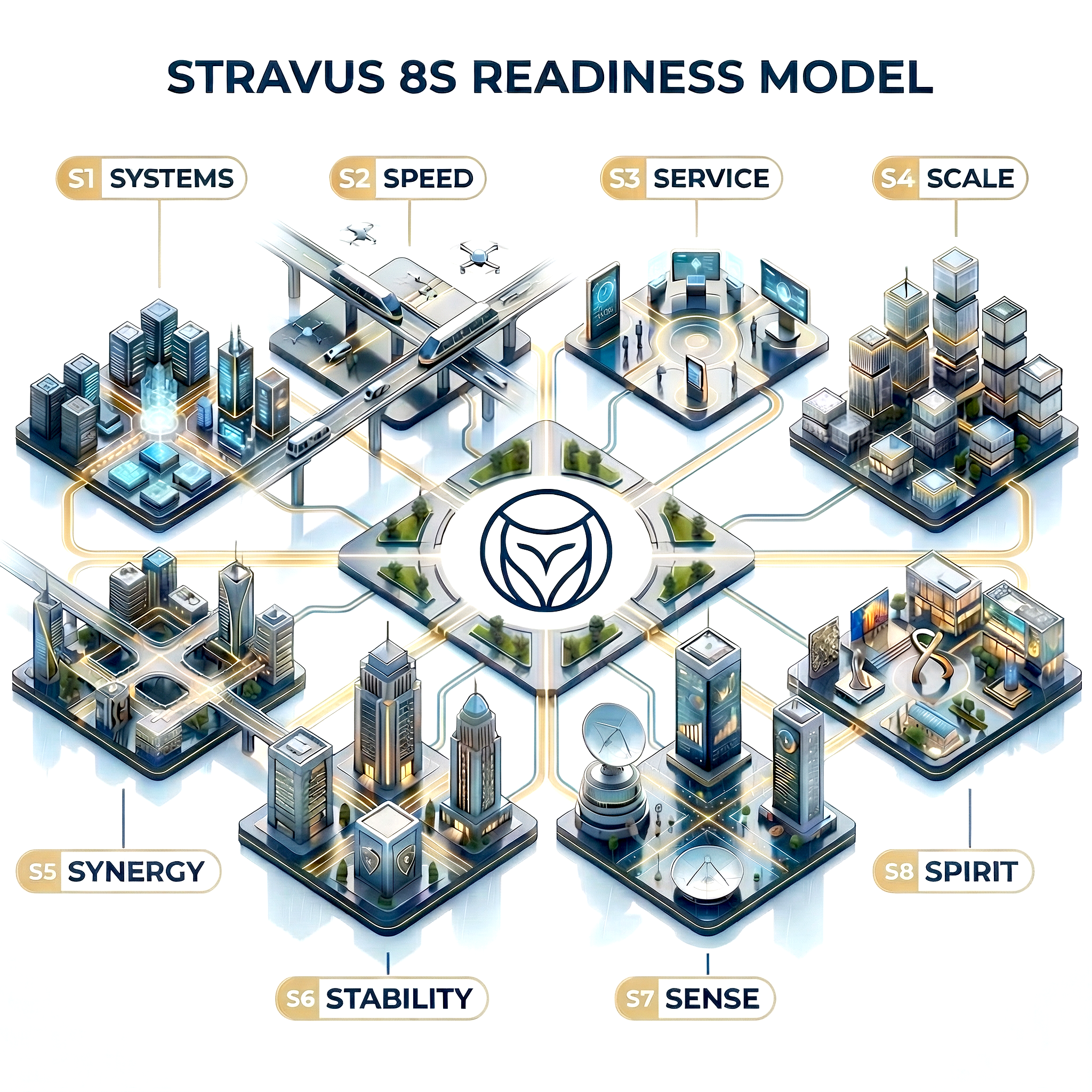
At Stravus, we assess readiness across eight foundational dimensions that together determine how effectively a business operates, adapts, and scales in the modern economy.
Each dimension looks at a specific part of how your business works - individually important, but most powerful when considered as a system.
Systems – Are your core operating tools and processes running efficiently?
Speed – How effectively are you leveraging AI and automation to accelerate growth?
Service – Are your customer interactions seamless, consistent, and memorable?
Scale – Can your product or service reliably deliver at higher volumes?
Synergy – Do your teams work together smoothly, with strong internal coordination?
Stability – Is your foundation resilient, from cybersecurity to operational continuity?
Sense – Are your decisions guided by real insight and actionable data?
Spirit – Does your culture inspire adaptability, leadership, and engagement?
Individually, each dimension affects performance.
Collectively, they determine whether a business compounds effort or compounds friction.
Most businesses don’t struggle because they’re weak everywhere.
They struggle because gaps in one or two dimensions undermine everything else.
This diagnostic reveals those gaps - clearly and objectively.
Four Readiness Archetypes
-

Survivor
You’re holding things together - but it feels harder than it should.
Your business runs, but mostly through effort, not systems. Processes are manual, tools don’t talk to each other, and key knowledge lives in people’s heads. Growth feels risky because everything feels stretched.
Survivors are often profitable, but fragile. When demand spikes, something breaks. When the environment shifts, there’s little room to adapt.
Focus: Stabilise the foundations, reduce friction, and create breathing room.
Next move: Build clarity, consistency, and control. -

Optimiser
You’ve improved efficiency - now you want momentum.
Your core systems are in place and things run more smoothly. You’ve digitised parts of the business, automated some workflows, and tightened operations. Performance is improving, but progress still feels incremental.
Optimisers often hit a ceiling: local improvements without systemic leverage. The business works better - but not fundamentally differently.
Focus: Connect systems, unlock speed, and turn efficiency into advantage.
Next move: Shift from optimisation to orchestration. -

Transformer
Your business is designed to scale - not just survive change.
Technology, data, and people are aligned around a clear operating model. Decisions move faster, systems work together, and growth no longer depends on heroic effort. The business adapts as conditions change.
Transformers aren’t reacting to disruption - they’re shaping their trajectory. They build capabilities once and reuse them everywhere.
Focus: Embed intelligence, resilience, and strategic optionality.
Next move: Turn capability into continuous advantage. -

Innovator
Your business creates leverage others can’t copy.
Innovation isn’t a project - it’s how the organisation thinks. Data flows in real time, experimentation is built in, and new opportunities are tested and scaled quickly. The business compounds learning, not just revenue.
Innovators don’t chase trends. They set the pace and redefine their category.
Focus: Continuous evolution, new value creation, and long-term leadership.
Outcome: A business that stays ahead — by design.