Mapping Your Digital Pathway: Maturity Models, Subway Maps, and Systemic Progress
In my book The Return of the Roaring 20s, I explore how a modern business behaves less like a simple machine and more like a living city. Today’s business environment is changing at breakneck speed – from the rise of AI and real-time data to digital-first customers and automation. These external shifts put intense pressure on the “city” inside your organisation: decision-making slows down, workarounds multiply, and founders often find themselves becoming the human routing layer keeping things moving. For business owners and transformation leaders, the challenge is clear: How do you map a pathway through this complexity to achieve true digital maturity?
The Four Levels of Digital Maturity: Survivor, Stabiliser, Optimiser, Innovator
One useful way to understand your organization’s digital maturity is through a 4-level maturity model. This model clusters patterns of organizational readiness into four stages: Survivor, Stabiliser, Optimiser, and Innovator. Each level reflects how well the business is leveraging digital capabilities to survive and thrive:
Survivor: At this foundational stage, the business is in survival mode – often reactive, patching together legacy systems and manual workarounds just to keep operations running. Digital efforts are ad-hoc. The focus is on firefighting immediate issues rather than long-term strategy. Many businesses start here, especially if they’ve grown quickly without investing in digital infrastructure.
Stabiliser: At this stage, the organization seeks stability and efficiency. It invests in core systems (for example, implementing an ERP or standardizing processes) to reduce chaos. A Stabiliser business moves from reactive to proactive in certain areas, establishing reliable repeatable processes. The goal is to stop “just surviving” and create a stable backbone for growth.
Optimiser: In the Optimiser stage, a business has a stable foundation and now focuses on continuous improvement and integration. Different systems and teams start working in concert. The company leverages data for decision-making, improves customer experiences, and drives efficiency across the board. Silos are breaking down. An Optimiser is pushing into best-in-class territory on multiple fronts, tuning the engine that was built in the Stabiliser phase.
Innovator: At the highest maturity, the organization is an Innovator – agile, adaptive, and often ahead of the curve. Innovators experiment with new technologies (AI, IoT, automation) and new business models. They aren’t just reacting to trends; they’re setting them. An Innovator-stage company has the digital savvy to reshape products, services, or even the industry. Importantly, an Innovator maintains the strengths of the earlier stages (stability, efficiency) while continuously reinventing itself.
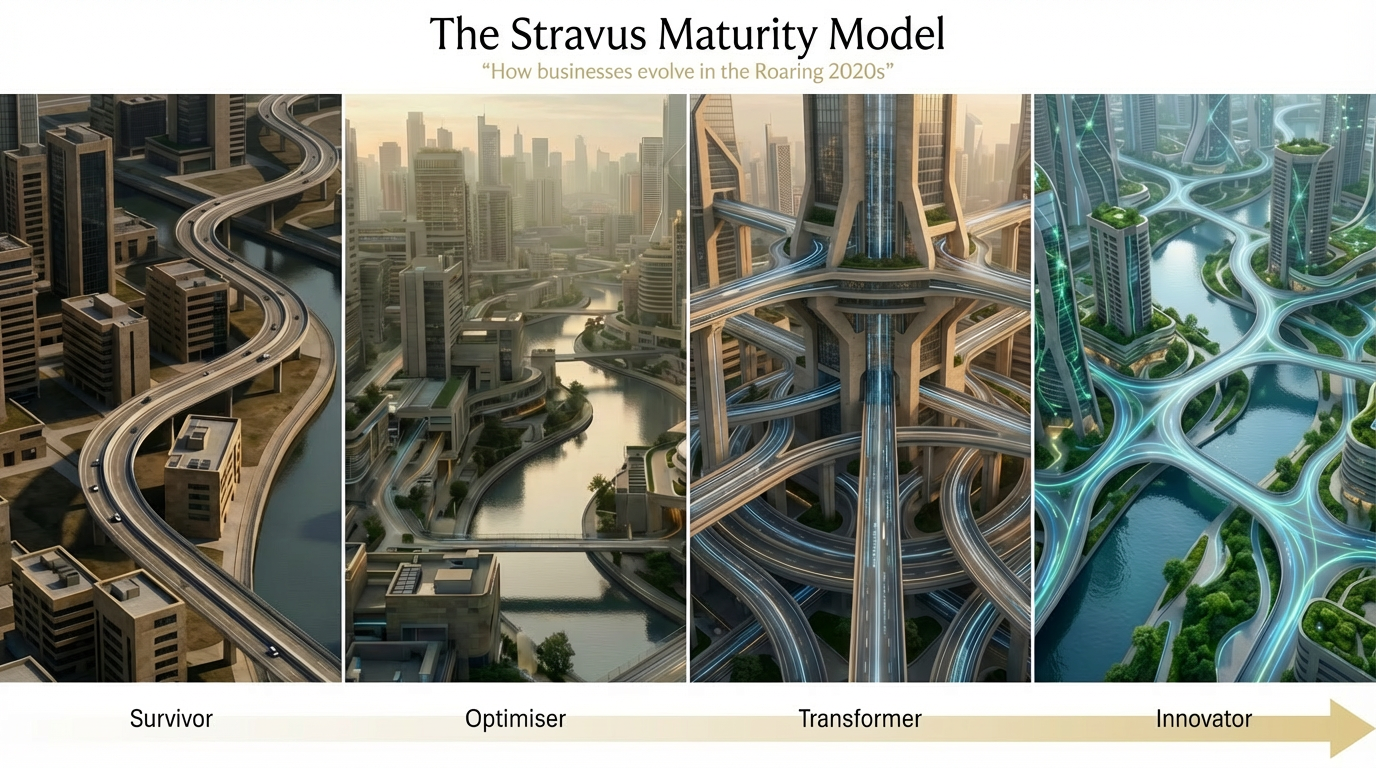
The Stravus Digital Maturity Model: How businesses evolve from fragmented survival to integrated innovation in the Roaring 2020s.
These four stages provide an anchor for understanding where you are on the digital journey. However – and this is critical – they are not a rigid staircase every business ascends step by step. In reality, progress is not so linear or uniform.
Diagnosing Maturity Across 8 Dimensions (The Stravus 8S Model)
Real organisations are complex. You might find that in some aspects of your business you’re already innovative, while in others you’re barely hanging on. This is why I use the Stravus 8S Model as a diagnostic lens in my work. The 8S Model views your business as a system with eight critical layers, analogous to a city’s infrastructure. It examines everything from how your business is powered and how value flows, to how customers experience it and how it scales. In practice, that means looking at dimensions like your strategy and purpose (how the business is powered), your value streams and processes (how value moves), customer experience (how customers experience it), organisational structure and capacity (how it scales), technology and data integration (how systems connect), security and risk (how it’s protected), sensing and feedback mechanisms (how it senses what’s happening), and talent and culture (how people operate it). Together, these layers provide a systemic view of digital readiness.
Crucially, this is not a simple checklist of things to do. In a healthy city, all parts of the infrastructure need to work in concert – and the same goes for a business. The 8S diagnostic doesn’t spit out one aggregated score that you either pass or fail. In fact, each of these layers can be at a very different level of maturity from the others. You might have modern, cloud-based systems (high maturity in “systems connect”), yet still rely on ad-hoc decision-making and lack strategic planning (low maturity in “how it’s powered” or strategy). This uneven maturity is more common than you’d think. As one of my posts notes, “Most businesses are – strong in some parts of the system, fragile in others, and blind to the constraint that matters most right now.” In other words, you could be an Innovator in one dimension and a Survivor in another.
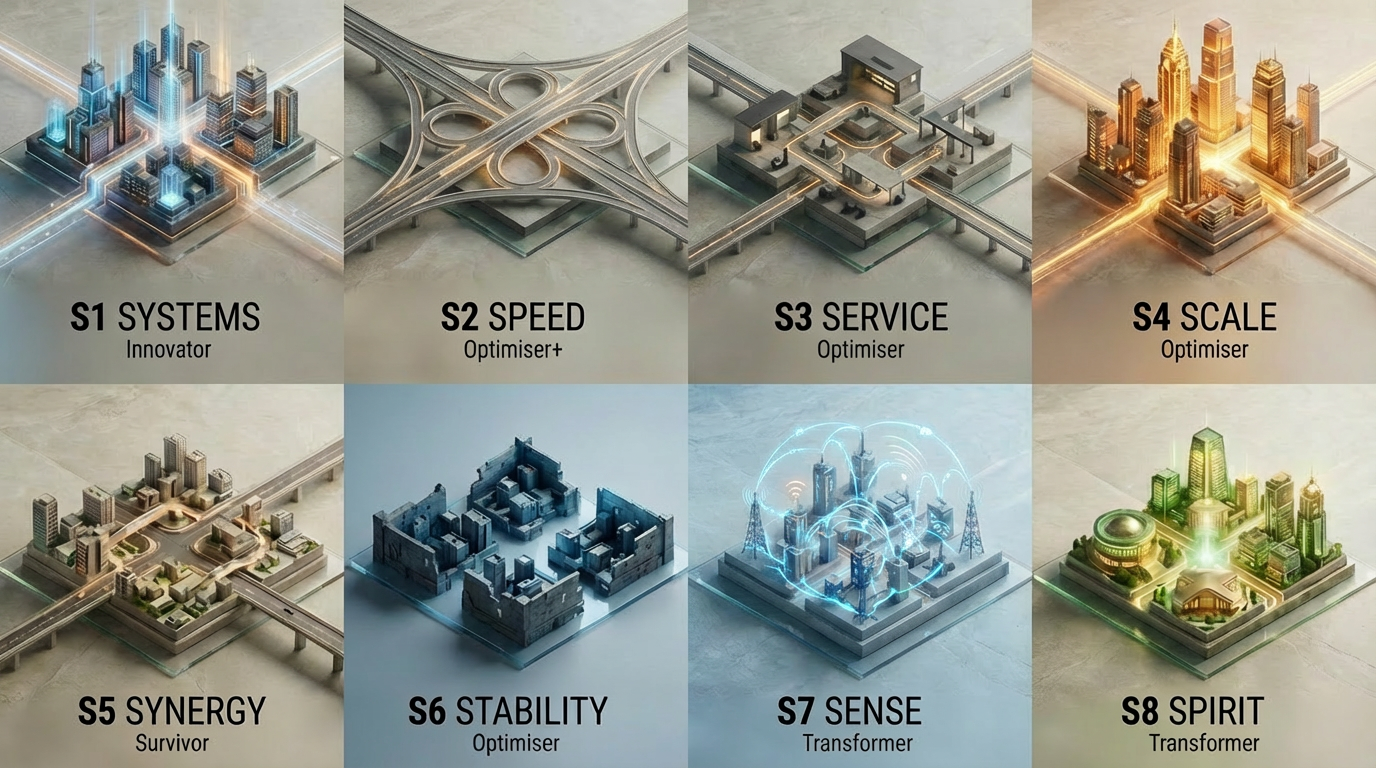
Sample 8S Diagnostic Snapshot: Visualising maturity across the eight Stravus dimensions, highlighting how digital readiness is uneven by design and where constraints sit.
This systemic, diagnostic approach is powerful because it highlights where your current constraints are. Instead of declaring your entire company simply “a Stabiliser” or “an Optimiser,” it shows why you are at that stage – which specific dimensions are holding you back. As I explain in Part III of my book, digital maturity is an emergent outcome of how well all these elements interconnect. If even one critical layer (say, data integration or talent skills) is far behind, it will constrain the whole system’s ability to progress. Maturity is uneven by nature, and that’s OK – as long as you can see the pattern and address the weakest links.
No One-Size-Fits-All Path: The Subway Map of Transformation
Given that maturity can vary across different aspects of the business, it follows that there is no one-size-fits-all sequence for digital transformation. Too many firms make the mistake of copying someone else’s roadmap step by step. In reality, “there is no 'one-size-fits-all' approach that will work for every organisation – companies need customised plans.” Every business has its own unique starting point and bottlenecks. Progress is constraint-driven: the next step on your journey should address your most pressing constraint, not someone else’s. As one analysis put it, each company must “take an exhaustive look at itself and find out what is most in need of an upgrade, and then focus on those aspects of operations”. In practice, that might mean your pathway prioritises, for example, fixing data quality and processes before investing in fancy new customer apps – or vice versa, depending on where your gaps are.
To visualise this concept, I love to use the subway map metaphor (which I introduce in Part III of The Return of the Roaring 20s). Imagine your transformation journey as a subway system with multiple lines and stations. Each “line” is a potential pathway or emphasis area (for example, one line might be the “data and automation” line, another the “customer experience” line, etc.), and the “stations” along the way are key milestones or capabilities you need to develop. Crucially, there are many ways to reach the destination of high digital maturity – just like there are many routes to traverse a city. “There is no one way to complete your journey. You may want to change subway lines… You can get on at any point and get off at any point.” In other words, you don’t necessarily start at the same station as anyone else, and you don’t have to stop at every station on the line either.

Visualising Your Digital Pathway: This subway-style map shows a transformation journey through the 8S model - highlighting that maturity is constraint-driven, not linear.
Think of the subway map visual: multiple lines intertwining, each line representing a different sequence of improvements a company might take. Some lines (pathways) might intersect at certain major stations – for example, almost every line might pass through a “digital culture” station at some point, highlighting how important culture change is no matter what path you take. Other lines might skip certain stops – indicating you might leapfrog a capability if it’s not critical for your strategy or if you’ve already developed it earlier via another route. The beauty of the subway metaphor is that it captures both direction and choice. You need a clear destination (say, moving from Stabiliser to Optimiser, or Optimiser to Innovator), and you need to choose the right line to get there, given your starting point. It reinforces that digital transformation is not a linear checklist but a journey with multiple routes. You might even change lines or transfer routes as new obstacles or opportunities emerge – and that’s normal. The key is to have the overall map of the system in view, so you can navigate alternate routes when you hit a dead end or delay.
By using a subway map approach, SME leaders can communicate the transformation plan in a way that teams understand: “We are here at this station now. Our next stop should be integrating our CRM with our e-commerce platform (next station), which will put us on track toward the Optimiser line. Eventually, we want to end up at the Innovator terminus, but there are a few ways to get there and we’ll choose the route based on what our current system needs most.” This encourages a culture of intentional sequencing – doing the right things in the right order for your situation, rather than blindly following a generic best-practice sequence.
From Fragmented to Coherent: A Systems Approach
Adopting a systems lens means recognising that true maturity is achieved only when all parts of the business system cohere. It’s not enough to implement one new technology or fix one process and declare “we’re transformed.” You have to ensure the changes actually gel with other areas. For example, if you introduce a powerful new CRM software but your team isn’t trained or your data is a mess, the benefit evaporates. As one technology leader observed, “if the company isn’t aligned, any technology strategy will fail… Without operational discipline, any technological tool will fail”. In other words, you need to have the right strategy, people, and processes in place (the business fundamentals) or digital tools won’t deliver results. Many companies hop from one shiny tool to the next, when the real issue is a lack of clarity and alignment in their system of work.
Using the 8S model helps reveal these disconnects. It forces you to ask systemic questions: Are our strategy and vision (how we’re powered) driving our tech investments, or are we just chasing trends? Are our processes and value streams (how value moves) aligned with our customer experience goals? Is our organisational structure (how we scale) flexible enough to support the new agile ways of working we’re trying to implement? If one part is out of sync, it can undermine all other efforts. A business might conclude a technology “doesn’t work,” when in fact “the reality is that nobody follows a process or adheres to a single configuration” needed to make that technology effective. Coherence across the 8S dimensions creates a kind of maturity that is resilient and self-reinforcing – it’s the difference between a city with synchronised traffic lights versus one with gridlock at every intersection.
The systemic approach also means measuring and monitoring the right things. Instead of only tracking project KPIs in silos, you look at holistic indicators of system health. How well is information flowing across departments? Where are decisions getting stuck? Are there bottlenecks in the “infrastructure” (be it skills, IT integration, or governance) that are limiting growth? By diagnosing these, you can target interventions that unlock progress. Many transformations fail not for lack of effort or budget, but because leaders try to force change in a silo without understanding the system interdependencies. “Transformation fails most often not because businesses choose the wrong solutions, but because they act before they understand the system they are changing.” Adopting a systemic mindset helps you avoid that pitfall.
Charting Your Path Forward: Assess, Align, and Advance
For business owners and transformation leaders embarking on digital transformation, the takeaway is this: know your starting point and your system’s profile before plotting the journey. This is why I developed the Stravus Digital Readiness Assessment – to serve as an entry point for understanding your own maturity and identifying the right pathway forward. In a few minutes, this free diagnostic (based on the 8S model described above) can give you an overall readiness score and a breakdown of strengths and weaknesses across those eight dimensions. Consider it your personalised “you are here” marker on the subway map. You might discover, for example, that your customer-facing tech is strong but your internal data practices are weak, pointing you to a pathway that prioritizes data infrastructure next.
With that clarity, you can focus your resources on the changes that will truly move the needle. Perhaps the assessment will show you’re largely in Stabiliser mode, with a couple of Optimiser pockets – so your path might involve shoring up the weakest areas (the constraint holding you back) to elevate the whole system. And when you’re ready to dive deeper, that initial snapshot can be the starting point for a more detailed roadmap: a clear view of where your “city” is robust and where it’s under strain, why those patterns exist, and what tends to unlock movement next.
Ultimately, mapping your digital pathway is about making informed choices. Don’t fall for the myth that transformation is a one-way highway or a boxed checklist. Instead, approach it like a dynamic map – one that acknowledges multiple routes and the reality that you must navigate around constraints. By understanding the four maturity levels, diagnosing yourself across the 8S dimensions, and embracing the subway map metaphor for planning, you equip your organization to make the right next move, not just the fashionable one.
Ready to chart your own digital journey? Start by honestly assessing where you stand.